From Core Rules. Read this book’s lore. Readable tables and original source diagrams.
GANG CREATION
When founding a gang, players have a maximum number of credits to spend on models, weapons and wargear chosen from the entries within their gang list. In general, the budget is 1,000 credits and this budget may not be exceeded during gang creation. Any unspent credits will be added to the gang's Stash if the gang has been founded for Campaign play. However, if a gang has been founded for Skirmish play, any unspent credits are simply lost.
CAMPAIGN PLAY
When founding a gang for Campaign play, the budget available is 1,000 credits. Should they wish, the Arbitrator can increase or decrease this budget.
FOUNDING AN ENDURING GANG
MODEL NAMES & TYPES
Each model available to a gang is of a named type; this is the name given to that model's rank within the gang hierarchy of their house. In addition, each model will have a Type denoted in their gang list entry. Model Types and Subtypes are explained in more detail on page 43. Very often the rules will refer to models by their Type or Subtype. In such cases, the rule is universal to all such models, regardless of their name. At other times, the rules will refer to a model by their specific name, 'Orlock Gunner', for example. In these cases, the rule is specific only to models with that name.
Once a gang has completed a campaign, it may be marked as Enduring in the Campaign Wrap-up. When founding a new gang for a campaign, players may use an Enduring gang they have previously controlled and explore what happens to the next generation.
GANG LEADER
The first step is to hire your gang's new Leader. The gang's previous Leader has permanently retired, their story told and someone new within the gang has taken over the reins. An Enduring gang may not hire a Leader from their gang list, instead a Fighter from the previous iteration of the gang must be selected to be the gang's new Leader - hire the Fighter for their Credit Cost with all Lasting Injuries, XP, weapons, wargear and skills carrying over. They then follow all of the steps outlined in Death of a Leader (see page 98).
TRIUMPH EFFECTS
If the gang earned any Triumphs in the last campaign they took part in, they select one and gain a bonus for the next campaign based on the selected Triumph.
| Triumph | Benefit |
|---|---|
| Dominator | The gang generates and starts the campaign with an additional Territory. |
| Slaughterer | After the gang has been founded, the gang gains 9 additional XP that can be distributed between models recruited from an old gang. Only 3 XP can be given to any single model. |
| Creditor | The gang starts with an extra 100 credits which are added to their starting Stash and may be spent when founding the gang. |
| Warmonger | The gang starts the campaign with an additional 2 Reputation and can choose to be the attacker or defender in their first battle, regardless of who issued the challenge. |
| Powerbroker | The gang can choose to start the campaign with one of the following Hangers-on for free (including any options): Ammo-Jack, Dome Runner, Hive Watcher, Rogue Doc or Slopper. |
These Triumph benefits are only retained for the gang's next campaign.
REHIRE GANG MODELS
In addition to hiring new models, an Enduring gang may hire any models from the previous iteration of the gang at gang creation for their Credits Value with all Lasting Injuries, XP, weapons, wargear and skills carrying over.
GANG COMPOSITION
The first step is to choose and purchase the models that make up the gang. Each of the different gang lists details all of the models available to that gang. These models are purchased by paying the Credit Cost shown in their entry from the budget available. Most gangs must always follow the rules presented below. In the case of any gangs that follow different rules, these will be presented as part of that gang's gang list:
There must be one model with the Leader Subtype.
The total number of models with the Champion, Brute or Hanger-on Subtype must always be less than or equal to the number of models without any of those Subtypes.
Should it occur during the course of a campaign that the number of models with the Champion, Brute or Hanger-on Subtype exceeds the total number of models without those Subtypes, the controlling player must either:
- Retire a number of models with the Champion, Brute or Hanger-on Subtype during the Post-cycle Sequence in order to correct the imbalance.
Or:
- Recruit fresh models without the Champion, Brute or Hanger-on Subtype during the Post-cycle Sequence in order to correct the imbalance.
DESIGNER'S NOTE: PETS
Pets are treated as wargear and as such are not counted when working out if a gang has too many models with the Champion, Brute or Hanger-on Subtype. However, many players find it handy to include Pets on the Gang Roster so that they can keep track of their XP, Lasting Injuries, whether they are In Recovery and if they have performed a Post-cycle Action.
WEAPONS & WARGEAR
The next step is to choose and purchase the weapons and wargear each model will be equipped with. Each model's entry within their gang list includes a detailed list of the weapons and wargear that model may purchase.
All models can be equipped as follows:
A Fighter can be equipped with a maximum of three weapons purchased from those listed in their entry. - Grenades are counted as wargear and not weapons and so do not count towards this maximum.
A Vehicle's entry will state if there is a maximum number of weapons it may be equipped with.
Weapons marked with an asterisk (*) take up the space of two weapons.
Any model may purchase wargear that is listed in the relevant Equipment List.
Each weapon may have at most one weapon accessory added to it.
EQUIPMENT SETS
Gang members often maintain an individual cache of weapons that allows them to equip themselves appropriately for each battle. As such, all models can have multiple Model Cards, each representing a different set of equipment:
The controlling player can make an additional Model Card for a model at any time.
An appropriate model should be available for each different equipment set a model has.
There is no additional cost for having multiple equipment sets. If, for example, an Orlock Road Captain owns a two-handed hammer, they may include that weapon in as many or as few different equipment sets as the controlling player wishes, without additional cost. The weapon is only purchased and paid for once.
Regardless of the number of equipment sets a model has, they still have a single entry on the Gang Roster. This entry should include the total cost of the individual weapons and items of wargear that the model owns. But remember, each individual weapon or item of wargear is only counted once.
If the model suffers any Lasting Injuries/Damage or gains any Advancements, it should be recorded on all of their Model Cards.
Only one of a model's cards can be used for a battle.
If a battle uses random models from the gang, all of the model's Model Cards should be shuffled together and one should be drawn at random and added to the rest of the gang's Model Cards before any cards are drawn. This means that only one of this model's Model Cards can be drawn for the battle, and that the controlling player cannot choose which of their equipment sets they will be using.
When distributing equipment from the gang's Stash, it can be moved to any number of Model Cards for that model.
MODEL CARDS
Finally, a blank Model Card should be completed for each model when they are added to the gang; the characteristics of the model and any equipment they . now have should be noted down in the appropriate sections of the model's Model Card.
DEATH OF A LEADER
All gangs must include a single Fighter with the Leader Subtype. This Fighter is, naturally, the Leader of the gang.
If a gang's Leader is killed, a new Leader must be nominated:
- The new Leader is the Fighter with the highest Leadership characteristic, selected from among those Fighters that have, in order of priority:
The Champion Subtype, but not the Loner Subtype.
Both the Champion and Loner Subtype.
Neither the Beast, Brute, Pet or Support Subtype.
Note that Vehicles and Hangers-on can never become a gang's Leader; if the only models left in a gang are Vehicles and Hangers-on, the gang is dissolved.
If two or more eligible Fighters have the same Leadership characteristic, use total XP as a tie-breaker; if there is still a tie, the controlling player can decide which Fighter will become the new gang Leader.
When a Fighter is promoted in this way, they gain the Leader Subtype, and from now on their role changes to that appropriate for their gang for the purposes of determining which equipment and Skill Sets they can access (for example, should an Orlock Road Sergeant be promoted to Leader, not only does their Subtype change from Champion to Leader, but their role becomes 'Orlock Road Captain'). They lose the Loner, Champion, Ganger and Prospect Subtypes if they have them, though their existing characteristics and special rules do not change. Any weapons or wargear they are currently equipped with is retained even if it is not allowed by their new role, but they may no longer purchase additional weapons or wargear only granted to their original role.
THE GANG ROSTER
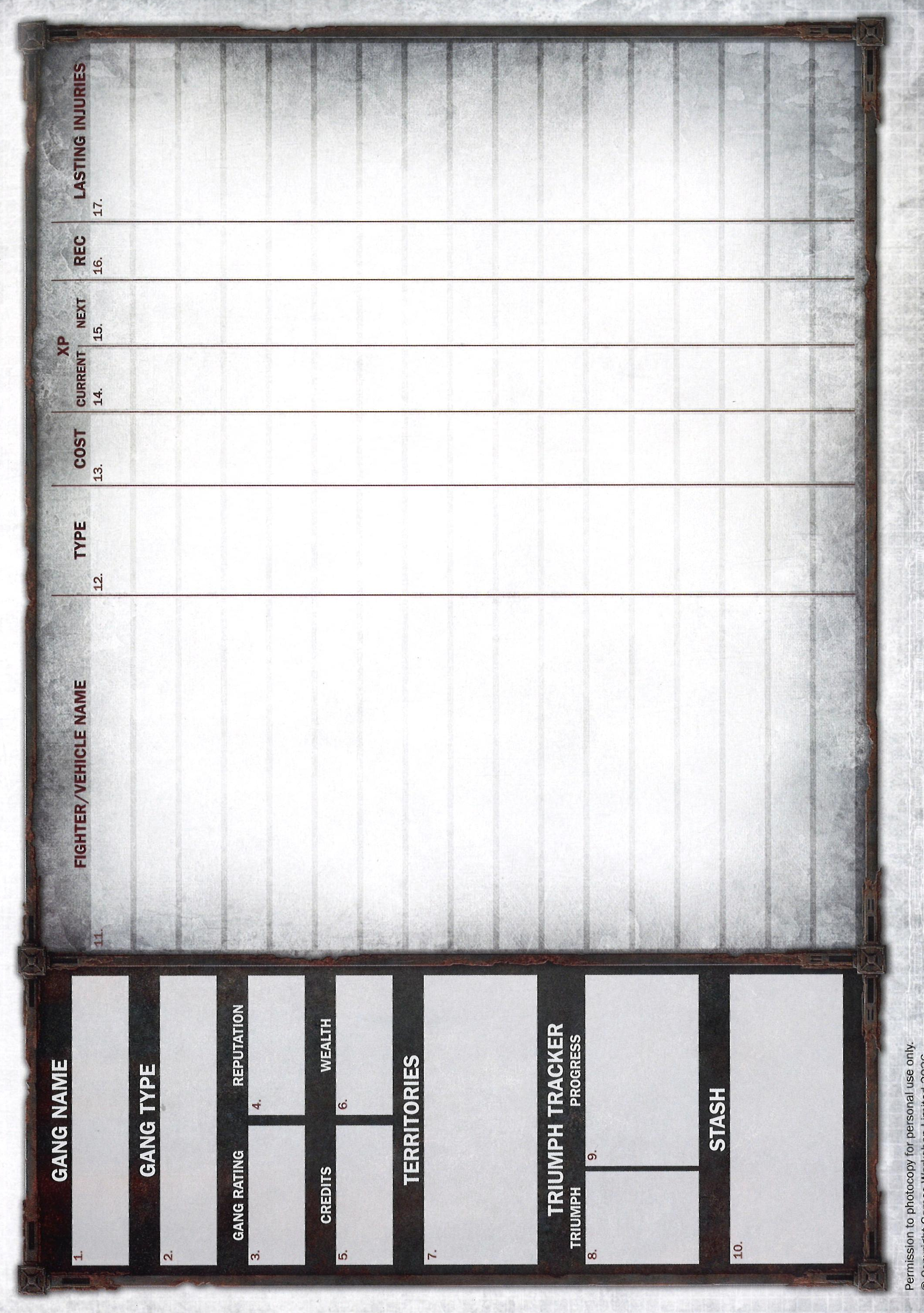
As well as filling in a Model Card for each model in their gang, players will need to complete a Gang Roster. This tracks additional information during Campaign play, such as Territories held, Gang Rating, Reputation, Wealth and so on, as well as each model's Experience and Advancements. During Skirmish play, such information is of less importance, but a Gang Roster is still a useful tool.
COMPLETING A GANG ROSTER
The Gang Roster is made up of a number of elements, as shown opposite. Many of these elements are explained over the following pages; those that are not are dealt with in detail in the campaign rules. These elements include the gang's name (1) and Type (2), its Gang Rating (3), Reputation (4) and unspent credits (5), Wealth (6), the Territories it holds (7), a list of the Triumphs used in the campaign (8), the gang's progress towards them (9) and its Stash (10), containing surplus equipment (both weapons and wargear).
The Gang Roster also has a line for each model in the gang, with space for their names (11), model Type (12), Credit Cost (13), Experience earned (14), the amount of XP needed for their next Advancement (15), and whether they are currently In Recovery (16) or have suffered any Lasting Injuries/Damage (17).
Note that, although the number of rows is limited, there is no upper limit on the number of models a gang can contain. Should a gang be lucky enough to have more models than can be fitted onto one Gang Roster, simply use a second Gang Roster for extra space.
GANG ATTRIBUTES
In Campaign play, gangs have a number of attributes, which are tracked on their Gang Roster. These attributes, and their starting values, are explained below:
GANG RATING
The Gang Rating is an indicator of how powerful the gang is - the proficiency of its models, how well equipped they are, and so on. The Gang Rating is the total cost of all of the models in the gang.
REPUTATION
Reputation is the measure of a gang's standing and power in their region of the underhive. It is separate from Gang Rating, which is a measure of the gang's size and resources; a small gang can build up quite an impressive Reputation. A gang's Reputation starts at 1, and cannot drop below 1.
WEALTH
In Campaign play, gangs also have a Wealth value this is equal to the total cost of all of the models in the gang, plus the value of any credits or equipment they have in their Stash.
MODEL CAMPAIGN ATTRIBUTES
In Campaign play, each model in a gang has a number of attributes that are tracked in their entry on the Gang's Roster:
EXPERIENCE (XP)
Models earn XP during battles and in the Post-cycle Sequence; this section lets you track how much XP they currently have and how much they need to gain their next Advancement.
IN RECOVERY
When a model goes Out of Action during a battle fought as part of a campaign, there is a chance that they will suffer a Lasting Injury or Lasting Damage (see pages 78-79). Many of these will cause them to go into Recovery and miss the rest of the Cycle. When this is the case, their In Recovery box is ticked.
Similarly, any Lasting Injuries/Damage that have a long-term effect on the model are also recorded on the Gang Roster.
 Blank Gang Roster form (as printed, sideways) Open full-size chart ↗
ON
0 (!) --