From Core Rules. Read this book’s lore. Readable tables and original source diagrams.
PDF page 74 / Printed page 72
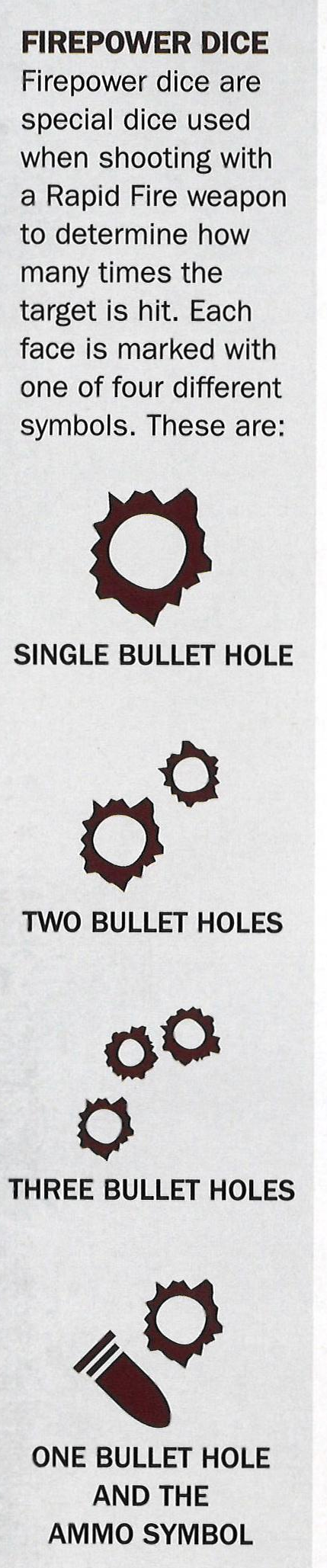
### FIREPOWER DICE
Firepower dice are special dice used when shooting with a Rapid Fire weapon to determine how many times the target is hit. Each face is marked with one of four different symbols. These are:
0
### SINGLE BULLET HOLE
### TWO BULLET HOLES
oO 0
### THREE BULLET HOLES
### ONE BULLET HOLE
### AND THE
### AMMO SYMBOL
### SHOOTING
When a model makes a ranged attack against one or more enemy models, this sequence is followed:
1. Declare the Shot
### ARBITRATOR'S TOOLKIT:
2. Measure Range
### STRAY SHOTS
3. Make the Hit Roll
If the attack misses, roll a D6
4. Resolve Hits for each model that is within 1" of the line along which the range
### 1. DECLARE THE SHOT
between the attacker and the
Choose a ranged weapon profile the target was measured, starting attacking model is equipped with and with the model closest to the nominate an enemy model in Line of attacker. On a roll of 1, 2 or 3,
Sight to be the target.
that model is hit by the attack. On a 4, 5 or 6, the shot misses
### 2. MEASURE RANGE
them - move on to the next model at risk of being hit.
Next, measure the distance between the model making the ranged attack and the target, to ensure that the
If the attack would have caused target is within the range of the more than one Hit, follow this weapon. If the target is out of range sequence for every Hit.
then the attack automatically misses.
### 3. MAKE THE HIT ROLL
### HIT MODELS BECOME SUPPRESSED
A Hit roll is a Ballistic Skill test
When a model is hit by a ranged attack made against the BS of the model they become Suppressed, unless they making the shot. There are many are also Engaged or are Seriously Injured/Damaged.
circumstances that may have an effect upon the Hit roll:
Falling from Heights: If a model
- Target is Engaged: If the target is becomes Suppressed or Seriously Injured/Damaged as the result of
Engaged, then if the shot hits, all Hits must be randomly allocated being hit by a ranged attack while they are within½" of a ledge they must between all models involved in the combat.
immediately check to see if they fall
- Target is Seriously Injured: If the
(see page 69). If they are within ½" of target is Seriously Injured then a -1 two ledges then they fall off the closer modifier is applied to the Hit roll.
ledge, if they are the same distance
- Rolls of a Natural 1: If the Hit away the controlling player may choose roll is a natural 1, then it misses, which ledge to fall off.
regardless of modifiers.
- Rolls of a Natural 6: If the Hit roll is a natural 6, then it hits, regardless of modifiers.
PDF page 75 / Printed page 73
### ARBITRATOR'S TOOLKIT: TARGET PRIORITY
If the Arbitrator wishes, they can represent the chaos and urgency of battle with the following rule: if the closest enemy model in Line of Sight is within 12" of the attacking model and is not either Engaged or Serlously Injured/Damaged, they must be the target of any ranged attack unless the attacking model passes a Cool check.
### 4. RESOLVE HITS
If the BS test is passed when making a Hit roll, a Hit is scored. Each Hit scored is resolved as described on page 76.
### RUNNING OUT OF AMMO
Although ammunition is plentiful for the most common weapons, some weapons use ammo up at such a high rate, or ammo is so hard to come by, that models can run out of ammo. This is represented by weapon traits such as Rapid Fire (X) and Ammo (X+).
When a weapon is Out of Ammo, it means that weapon cannot be used again until a Reload action is taken. Upon successfully completing a Reload action, the weapon can be used once more.
### MULTIPLE WEAPON PROFILES
Many weapons have multiple weapon profiles representing different kinds of ammo for that weapon. When a weapon goes Out of Ammo only the profile used for the attack goes Out of Ammo, other profiles may still be used as normal. When the Reload action is performed, only one of a weapon's profiles (of the controlling player's choice) has the Out of Ammo Condition removed.
### RAPID FIRE (X)
Some weapons fire a huge quantity of shots at one time; these are represented by the Rapid Fire (X) trait. When firing a weapon with this trait, you may also roll a number of Firepower dice up to X. If the attack hits, resolve a number of Hits equal to the number of bullet holes across all the Firepower dice.
Regardless of whether the shots hit or not, if any ammo symbols are rolled the weapon has run Out of Ammo. If multiple ammo symbols are rolled then the weapon jams and cannot be used again this battle. A weapon with the Ammo (X+) trait may be considered to have rolled one additional ammo symbol.
Weapons with both the Rapid Fire (X) and Light traits can only fire single shots when used in close combat - the Firepower dice is never rolled when using them in this manner.
### ARBITRATOR'S TOOLKIT: WALKING FIRE
If a Rapid Fire weapon scores more than one Hit, the Hits can be split between multiple targets. The first must be allocated to the original target, but the remainder can be allocated to other enemy models within 3" of the first who are also within range and Line of Sight. Allocate all of the Hits before making any Wound rolls.
### BLAST & TEMPLATE WEAPONS
The full rules for how both the Blast (3"/5") and Template traits work can be found on pages 162 and 165. Some of the more common situations are covered below:
Hitting Engaged Models: If a weapon with either the Template or Blast (3"/5") trait hits a model that is Engaged, then every model (both friend and foe) that model is Engaged with is automatically hit.
Hitting Models on Different Levels: When resolving a Hit from a weapon with either the Template or Blast (3"/5") trait, only models on the same level as the targeted model may be hit by the attack. This means if a Blast marker scatters off a ledge, it remains on the same level and explodes in mid-air.